Showing posts with label 05-Weimar Germany. Show all posts

Tuesday, February 26, 2013

336LG-05B-Weimar Germany and Doeblin


Listening Guide for

Lecture 05B: Weimar Politics (Basics) and Doeblin, Berlin Alexanderplatz


  • 0:00 General discussion of main issues in Weimar politics.  References to Orlow can be replaced with background readings of Gordon Craig and Voelker Berghahn in their chapters on the Weimar period. All of these issues are covered in those texts. 
    • Failure of Last Offensive; end of war. 
    • SPD-led Reichstag left to deal with results. 
    • German Left split, theoretically, by war, and then afterward.
    • Two Republics founded, Nov. 9, 1918.

      • Declaration of the Republic (Phillip Scheidemann--SPD), 9 November 1918

      • Karl Liebknecht pressing for Soviet Republic, late 1918.
    • Freikorps active on German streets: multiple images
    • Murders of Karl and Rosa 
      • The death of Rosa Luxemburg was a heavy blow to the German proletariat which had lost one of its best leaders. Picture from Bundesarchiv.
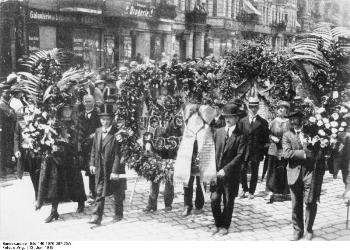
        Funeral of Karl and Rosa
      • Kaethe Kollwitz tribute to Liebknecht
    • Weimar Constitution: liberal, modern charter.
      • Proportional representation leading to splintering
      • Article 48: government by Emergency Decree by Chancellor--precedents for Hitler's assumption of power
    • Versailles Treaty
    • Economic disaster: hyperinflation [images and charts]
    • Paramilitary political organizations: militarization and brutalization of Weimar politics.
    • Book takes place during "Golden Years" of Weimar era: relative economic stabilization due to Dawes and Young Plans--roughly 1924-29.
  • 18:30: Start Analysis of Doeblin, Berlin Alexanderplatz
  • Follow page numbers from here: 1-213.

Sunday, February 17, 2013

Required Background Materials

As you know, I made Orlow's A History of Modern Germany a "recommended" text. There, you will find the basic narrative of political, social, and some cultural history that lies behind the specific issues/themes/sources we are discussing. I will discuss the take-home assignment this week, but you will need to use Orlow, or some other basic history, to set up the background to the era that you write about more specifically. Lecture notes will help, but your exams will need to be more specific than my summaries.

I could scan portions of Orlow for you, in case you didn't buy it. But in this age of online resources, I'm not sure that is necessary. In the mean time, you can use a variety of general German histories online (or on paper = books). For the moment, I have added to your _required background readings_ links to this site: "German History in Documents and Images," which was a collaboration among some of the leading historians of Germany. It provides some basic information about each era we are covering, as well as some other primary sources.

The key think to realize is that Wikipedia is just the TIP OF THE ICEBERG. More and more _professional_ materials are now online, with more added every day. At least search Google Books when looking for references to use in any of your written course work. But even better, take advantage of the resources that the LUC libraries are using YOUR TUITION MONEY to purchase--these are VERY excellent resources that YOU ARE PAYING FOR. Impress your professors by citing these rather than the Wikipedia articles we read over and over!

For instance, I just did a search on the LUC libraries site, within the EBL database, which is getting more and more full e-books that you can use for all your classes. The keywords "history germany" brought up over 4,000 titles (!). I will look through these, but here are a couple of obvious sources to use on this excellent resource:
EBSCO Search

ACLS Humanities Search Results: these are CLASSICS
Cambridge Histories: unbelievable resources for any classes

Cambridge Handbooks unbelievable resources for any classes

Read on! -DD