Listening Guide for
Lecture 05B: Weimar Politics (Basics) and Doeblin, Berlin Alexanderplatz
- 0:00 General discussion of main issues in Weimar politics. References to Orlow can be replaced with background readings of Gordon Craig and Voelker Berghahn in their chapters on the Weimar period. All of these issues are covered in those texts.
- Failure of Last Offensive; end of war.
- SPD-led Reichstag left to deal with results.
- German Left split, theoretically, by war, and then afterward.
- Two Republics founded, Nov. 9, 1918.

Declaration of the Republic (Phillip Scheidemann--SPD), 9 November 1918
Karl Liebknecht pressing for Soviet Republic, late 1918.
- Freikorps active on German streets: multiple images
- Murders of Karl and Rosa

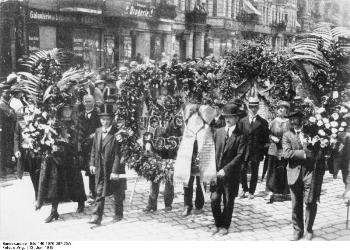
Funeral of Karl and Rosa
- Kaethe Kollwitz tribute to Liebknecht
- Weimar Constitution: liberal, modern charter.
- Proportional representation leading to splintering
- Article 48: government by Emergency Decree by Chancellor--precedents for Hitler's assumption of power
- Versailles Treaty
- Economic disaster: hyperinflation [images and charts]
- Paramilitary political organizations: militarization and brutalization of Weimar politics.
- Book takes place during "Golden Years" of Weimar era: relative economic stabilization due to Dawes and Young Plans--roughly 1924-29.
- 18:30: Start Analysis of Doeblin, Berlin Alexanderplatz.
- Follow page numbers from here: 1-213.
01: Introduction to Course
- 0:00-6:49 Opening comments.
- 6:49-40:53 Discussion of Triumph of the Will and what cultural and intellectual historians do with it in studying history of National Socialism. Timings in Triumph of the Will on YOUTUBE: [http://youtu.be/GHs2coAzLJ8 [Whole]
- 37:57-40:53 Discussion of cultural historical approach to German history.
- 40:53-44:37 Discussion of the various German Flags on the site:
- Image of Flag: Imperial-Wilhelmine Germany

- Image of Flag: 1848 & Weimar & West Germany & Berlin Republic (today)
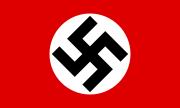
- Image of Flag: Nazi Germany
- Image of Flag: East Germany

- 44:37-51:23 Background of multiple “Germanies,” or multiple notions of what “Germany” might be, from 18th century on.
- 51:23-53:29 Brief summary of Bismarck’s “Small German” Unification in 1870-71.
- 53:29-58:16 Reiteration of main point that there have long been many Germanies: geographical, cultural, and political.